#1 - Ode to Cal Trans
by Hector Tobar:

http://www.hollywoodfreewaycentralpark.org/docs/HFCP_Visualize.pdf
http://www.lhttp/www.lataco.com/taco/bombing-the-101-hollywood-freeway
http://en.wikipedia.org/wiki/Caltrans
http://caltrans-opac.ca.gov/construc.htm
http://caltrans-opac.ca.gov/construc.htm
Bombing the 101 ~ Hollywood Freeway

In a state report card (.pdf) evaluating all the Caltrans districts, 7, which is responsible for Los Angeles and Ventura counties, has the worst grade. "It's actually kind of appalling," a staff member of Councilwoman commented.

110 & 105 Interchange

Los Angeles Interchange complex is the busiest freeway.
East Los Angeles Interchange complex is the busiest http://www.bing.com/images/search?q=pictures+of+the+L.A.+freeway&go=&form=QBIR&qs=n#focal=258725ade8b221e5031568863192d166&furl=http%3A%2F%2Fwww.withfriendship.com%2Fuser%2Fimages%2F567%2Finterchange.jpg
“The people of Southern California are in a love hate relationship with their freeways. The logo of Los Angeles could be a number of things, but it might very well in fact be one of the automobile. There is an intensity and power found on Los Angeles freeways rarely found in other big cities. The freeways in Los Angeles were among the first and oldest in the nation. When there is little traffic on the freeways, typically extremely late at night but during the day as well depending on which freeway in question and the time of day, they work wonderfully - you can zip around from city to city, from freeway to freeway just like that.”
http://www.davestravelcorner.com/articles/los-angeles/LA-Freeways.htm

These freeways can be crowded and frustrating to the drivers on them. To experience driving in the L.A. area you know what is meant by this. People are well aware of exactly what you mean. Known as the arteries of the L.A. basin these freeways are often clogged.

#2 – montalva, myths and dreams of home
By Thomas Steinbeck
Big Sur

McWay Cove and waterfall at Julia Pfeiffer Burns State Park - Photo: ©Stan Russell
History: The first people to inhabit Big Sur were the Native American tribes; Ohlone, Esselen, and Salinan. They lived in Big Sur for thousands of years. Spanish mariners were the first Europeans to observe Big Sur, led by Juan Cabrillo in 1542. Colonizing this southern area in 1770, led by Gaspar de Portola. This was along with Father Juniper’s Serra founding the missions in the Monterey Bay. Given the name for this region; “pais grande del sur”, meaning “Big South Country”. The rest of Big Sur became part of Mexico when it gained its independence from Spain in 1821, with the rest of California. In the 1800’s there was a gold rush boom in this area along with most of the redwood trees being cut down.
Big Sur Natural History
Information and articles about the diverse natural history of Big Sur, Monterey County, and the Central Coast of California. The articles by Steven Harper were previously published in Monterey County magazine and Big Sur magazine.
Steven K Harper http://www.stevenkharper.com/history/
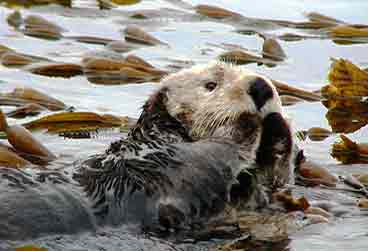
Kings of the Kelp: California Sea Otters

The Dark Watchers of California: http://en.wikipedia.org/wiki/History_of_California_to_1899
“From about Avila Beach, through San Luis Obispo, and all the way up to Monterey, runs the Santa Lucia Mountains. Lurking within these mountains are the strange and mystifying Dark Watchers. The Dark Watchers, as they have come to be known, are apparently giant human like phantoms that are only seen at twilight, standing silhouetted against the night sky along the ridges and peaks of the mountain range. When spotted, the beings are usually seen staring off into the open air of the mountains seemingly at nothing in particular before vanishing into thin air occasionally right before the spectators eyes. Who or what the Watchers are, no one knows. Where they came from or why they are there, again lost in speculation. And what they are looking for or watching is beyond anyone's current comprehension.” http://www.weirdca.com/location.php?location=179rnia
#3 – The Last Little Beach Town
By Edward Humes
Seal Beach

Photos above show the Seal Beach beaches, Seal Beach Main Street, Red Car Museum, Slick - The Seal Beach mascot on the Seal Beach Pier and a picture of the Seal Beach Pier.
Seal Beach is located at the northern most corner of Orange County boarding Los Angeles county of California. It is a quaint old fashioned town that that has the old time feel of America during the mid 1900’s; including a beautiful beach and pier. It was named for the seals that used to swarm the waters; most of the seals have left the area. Today Seal Beach is a quiet family friendly town with a great location for swimming, dining, fishing, shopping, windsurfing, and kite surfing. It also is where a T.V. crew occasionally might set up a shoot. Seal Beach is a fun place to visit.
http://www.beachcalifornia.com/seal.html

http://en.wikipedia.org/wiki/Seal_Beach,_California
This looks like a fun place to visit.
#4 – Surfing
By Matt Warshaw

Riding these amazing Maverick waves is beautiful. These pictures are from the Maverick Surf contest in Half Moon Bay of 2006. I think the photos tell the story the best.
http://www.oceanlight.com/spotlight.php?img=15308
“Just off the Half Moon Bay coast, winter storms and underwater geography combine to create some the world's biggest and most dangerous waves. The Mavericks Surf Contest gives the world's best surfers a chance to pit their skills against the big ones that can rise over 50 feet high, but this contest has an interesting twist. No one knows when it will be held until just 24 hours before it starts.”
http://gocalifornia.about.com/od/topcalifornia/a/mavericks_surf.htm


The Mavericks Surf Contest
The first Mavericks Surf contest was held in 1999. It takes place at an ocean reef off Pillar Point near Half Moon Bay. The best time to catch the big waves would be in the winter; December to March. Someone watching the waves sends information when the conditions are right to 24 preselected contestants. The surfers then have 24 hours to make it to compete in the Contest. The winner can win up to $30,000.
10 Students Views:
Aloma: “I never knew that the weigh of a tractor would make a difference on the soil and crops. But now when I really think about it, it does.” - This is an interesting fact that I just would never have thought would have made a big difference.
Daniel: “What I learned through this reading was about Seal Beach itself. I had never heard of the area, a couple years ago I had spent 3 weeks in Southern California, I was within 10 minutes of this area, and never knew it was there. Sounds like a great place to stop on another trip.” – I never heard of Seal Beach either until I read this story. I would like to visit there some day.
Marissa: “I did not know CalTrans put out a white helmet that acted as a memorial for a worker that was killed. It is a nice gesture but I also know they take them down as they did not want the highway looking like a cemetery.” – I had never heard of this, it is a respectful act.
Nicholas: “Didn’t know: Maverick’s is named after a white-haired German Shepherd that loved to surf.” - I was not aware of this until I read the story, interesting.
Teresa: “Three Hawaiian teenagers attending military school were the first surfers in America, the year was 1885.” - This was a very fascinating fact to me.
Terrie: “The one thing I didn’t know: I was interested in the results of the teachers science-test. I did not know that if you cover a piece of cardboard with Vaseline and face it toward the freeway that it will turn back in a few days. Such an eye opener on how cars cause such pollution.” – I thought this was an interesting, along with being a humorous fact also. Simple facts.
Vanessa: “I did not know that in a lot of other countries there is no real distinctive freeways or highways where pedestrians etc weren’t allowed to walk around.” – It is interesting to think that our country is so unique.
Lemlem: “That Berkeley population is more than one hundred thousand people with another thirty thousand to account for the transient population of UC Berkeley.” – This is an interesting fact I just never thought about.
Chandavid: “Amusement parks have not changed so drastically since the past.” - It is interesting to think that with all the advanced technology we have, amusement parks just go about pretty much being the same.
Rachel: “The first myths of California were bon in the early 1500’s. It’s hard to imagine that back in the early 1500’s people were inspired by the myths and thoughts of a paradise filled with opportunity and wealth.” – I felt the same way after reading this story. It is hard to believe that California was thought of this way so long ago.



No comments:
Post a Comment